


Most parents get the same thing wrong about ball pit balls. They spend hours reading about choking risks and toxic plastics. But they barely think about the stuff that causes problems at home, like picking the wrong size ball or skipping basic checks before their toddler dives in.
And we’ve noticed that most online advice mixes up genuine child safety concerns with everyday annoyances like mess or colour fading. So, it’s tough to figure out what deserves your attention and what you can sort out with a bit of planning.
Here at Made Minimal, we stock kids’ toys and play products built around safe, simple design for Australian families. And in this article, we’ll break down what to look for when you choose, use, and clean ball pit balls at home.
Let’s start by separating problems that affect your child’s safety from problems that just annoy you as a parent.
Ball Pit Balls and Choking Risks: What Parents Should Know
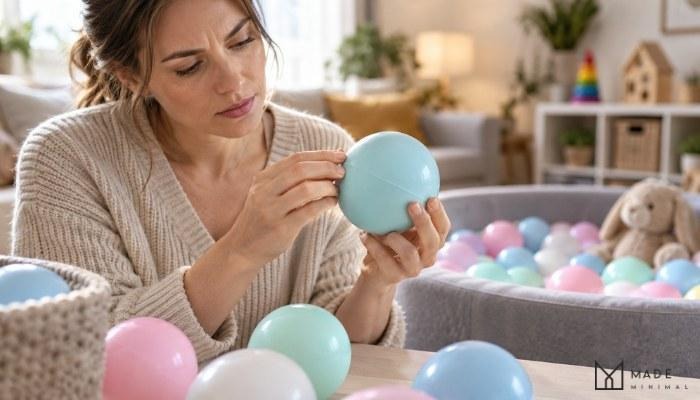
A standard ball pit ball, at 7 cm across, won’t fit into a toddler’s airway. That single fact eliminates the number one fear most parents have about ball pit balls.
The real risks sit in places you’d never think to check, which we cover below.
Hazard, Hassle, or Value Problem?
Parents can treat every ball pit problem as a safety issue, but the concerns aren’t all the same. They roughly fall into three categories: safety hazards, everyday hassles, and poor value.
Safety hazards come first since they can cause actual harm. Undersized balls, cracked balls with sharp edges, or small toys hidden under the balls can create these risks. In fact, around 2,500 Australian children under three go to emergency departments each year because of injuries from unsuitable toys. While that figure covers all toys, not ball pits specifically, it shows why checking the products your child uses is worth a few minutes.
A hassle, on the other hand, is a completely different ballpark. Balls rolling across the lounge room, running out of storage space, and cleaning hundreds of plastic balls can take time. But nobody is getting hurt by a ball under the couch.
And then there’s the value problem. You might pay $60 for a set of 500 balls only for your toddler to lose interest after two weeks. That stings your wallet, but again, nobody got injured.
The Ball Isn’t Necessarily the Choking Hazard
Many parents assume every plastic ball is a choking risk, but the size is important.
Most ball pit balls made for toddlers measure between 6 cm and 7 cm across (roughly the size of a tennis ball). The ACCC uses a small parts cylinder measuring 31 mm wide and 57 mm long to test choking risks. A regular ball is too large to fit inside that cylinder, so an intact ball doesn’t present the same choking risk as a small toy.
So, what you should check is:
- The age recommendation on the packaging
- The actual ball dimensions listed by the manufacturer
- The condition of each ball after a few months of regular play.
Cracked or split balls can break into smaller, jagged pieces over time, and those pieces are a completely different risk to the original product.
Once you’ve checked the balls for damage, it’s worth looking at what may be collecting underneath them. Small toys, hair clips, food scraps and coins can sink to the bottom of a home play area and stay hidden for days.
So empty the entire pit every couple of weeks and check what has collected underneath. And remember, if an object fits inside a 31 mm film canister, it’s considered a choking hazard for children under three.
Planning for the Mess Beats Complaining About It
Nobody enjoys picking up 300 balls from behind the couch at 9 pm on a Tuesday. It’s a fair complaint, and it’s common among parents who use ball pits at home.
The mess doesn’t mean a ball pit can’t work indoors. It usually comes down to how the play area is set up. That’s why you should choose a room with a door you can close, so balls stay contained during play. A pop-up pit with high walls can also keep more balls inside, while a mesh bag or lidded basket gives you somewhere to store them afterwards.
Planning these details before you buy makes cleanup much easier. So, think about where the pit will go, where you’ll store the balls and how you’ll tidy them away after play.
What Safety Standards Don’t Tell You About Ball Pit Balls
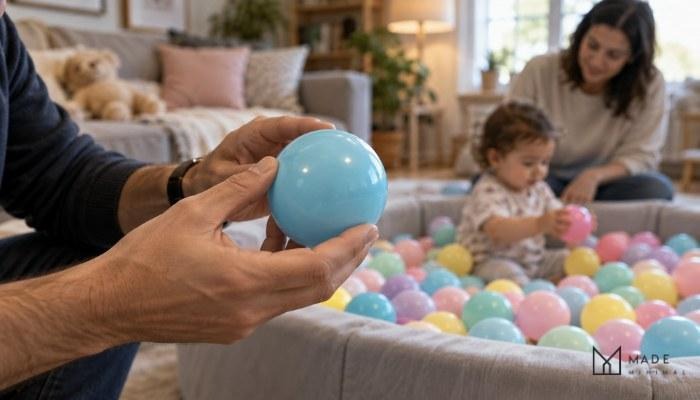
Safety standards set the minimum bar. This means that they tell manufacturers what to test, but don’t tell you what to look for once a product lands on your doorstep. So let’s walk through what you can check yourself.
Safe Kids’ Products Need to Survive Toddler Play
Toddlers squeeze, bite, throw, sit on, and stomp on ball pit balls during normal play. That repeated pressure puts the plastic through plenty of daily wear.
This means a pretty pastel set can crack after a few weeks if the plastic is too thin or rigid. So what’s more important than appearance is the material and how the ball is made.
We recommend looking for balls labelled as LDPE plastic, which stands for low-density polyethylene. LDPE is flexible enough to compress under pressure and spring back to its original shape without splitting.
The material also needs to be safe for young children who may chew or suck on the balls. Check that the product is BPA-free and phthalate-free, and make sure it meets Australian safety requirements for restricted chemicals. For example, children’s plastic items containing more than 1% DEHP by weight are permanently banned in Australia because DEHP can pose reproductive health risks.
Inspect What Arrives at Your Door
No amount of online research replaces opening the box and checking things with your own hands. Before your child touches a single ball, run through this quick checklist:
- Age Recommendation: The product should be rated for your child’s specific age group. In Australia, toys for children under 36 months must meet a mandatory safety standard covering choking risks, small parts, and battery compartments.
- Dimensions and Materials: A 7 cm diameter is the recommended minimum for toddlers because it’s too large to fit in a child’s airway. The ball size and plastic type should be clearly printed on the packaging, and if that information is missing, treat it as a red flag.
- Instructions and Warnings: Similarly, reputable brands always include printed care and safety instructions. The absence of any guidance usually signals a lower-quality product that cut corners elsewhere too.
- Pressure Test: Squeeze a ball firmly between your fingers. It should compress and spring back to a round shape without cracking, staying dented, or feeling brittle.
- Visible Damage: Even one damaged ball in a batch of 200 is worth removing. Look closely for split seams, surface cracks, rough edges, or balls that feel unusually soft compared to the rest of the set.
- Confidence Check: By this point, you should have enough product information to feel good about the purchase. A vague online listing paired with bare packaging is a sign to reconsider before your child starts playing.
And don’t stop checking after day one. Toddlers put plenty of pressure on everything they touch, so inspect the balls every few weeks. If any are cracked, split, or losing their shape, pull them out straight away. Leaving damaged items buried at the bottom of the pit is exactly how little ones find things they shouldn’t.
Cleaning Is Simple, but Cleaning Hundreds Takes Time
Wiping one plastic ball takes about two seconds. Wiping 400 of them takes the better part of an evening, and most articles skip right over that reality.
The good thing is you don’t need to disinfect every ball after ordinary play. A wipe-down with warm water and a mild detergent in small batches is plenty for regular upkeep. A few simple habits can help keep the ball pit cleaner and make regular cleaning easier:
- Keeping food and drinks away from the pit during play
- Dealing with spills or illness straight away
- Following whatever cleaning instructions came with the product
Some plastic balls have small air holes that can let water inside during washing. If that moisture stays trapped, mould can grow over time. And drying is an easy step to miss when cleaning ball pit balls.
So after washing, spread the balls across a clean towel in a well-ventilated area. Then let them dry completely before putting them back in the pit.
This way, you remove trapped moisture before it can create a new hygiene problem.
Make a Home Ball Pit Safer for Toddlers
You don’t need to treat ball pit balls as perfectly safe or automatically dangerous. The answer sits in between, and a few practical questions before you buy will sort out most of the worry:
- Is the product right for your child’s age?
- Does it feel solid in your hands?
- Can you store, check, and clean this many balls without it becoming a chore?
We agree that product safety and sensible supervision both play their own role in keeping children safe, so one shouldn’t have to make up for the other. If the balls are the wrong size or poorly made, keeping a closer eye on your toddler won’t fix that problem.
And yes, balls will escape. Children will fling them into every corner of the house (that’s just what play looks like). And a bit of thought about your room layout and storage ahead of time will keep the mess from becoming a nightly headache.
Browse our kids’ toys and play products at Made Minimal to find something that works for your family.