
Your master bedroom should be a sanctuary, a place where you can unwind after a long day and sleep soundly without distractions. Whether you’re planning a full master bedroom renovation or making targeted improvements, thoughtful design choices can dramatically improve both the function and feel of the space. This guide walks you through practical renovation ideas that balance aesthetics with comfort, helping you create a bedroom that truly reflects your personal style while meeting your daily needs.
Key Takeaways
- Master bedroom renovation ideas should prioritize a calming color palette—soft grays, warm whites, and muted blues—combined with layered lighting to create both mood and functionality.
- Upgrading flooring with luxury vinyl planks or high-quality area rugs improves comfort underfoot while offering easy maintenance and cost-effective alternatives to hardwood.
- Built-in storage solutions and closet organizers eliminate clutter and maximize square footage, making the bedroom feel more spacious and relaxing.
- Layered window treatments combining blackout curtains with sheers provide superior light and temperature control while maintaining privacy and energy efficiency.
- Strategic furniture arrangement—positioning the bed in the command position and leaving adequate walking space—improves both comfort and flow without over-furnishing the room.
- A successful master bedroom renovation balances aesthetics with practical function by measuring twice, prepping thoroughly, and prioritizing usability alongside personal style.
Choosing a Fresh Color Palette for Mood and Relaxation
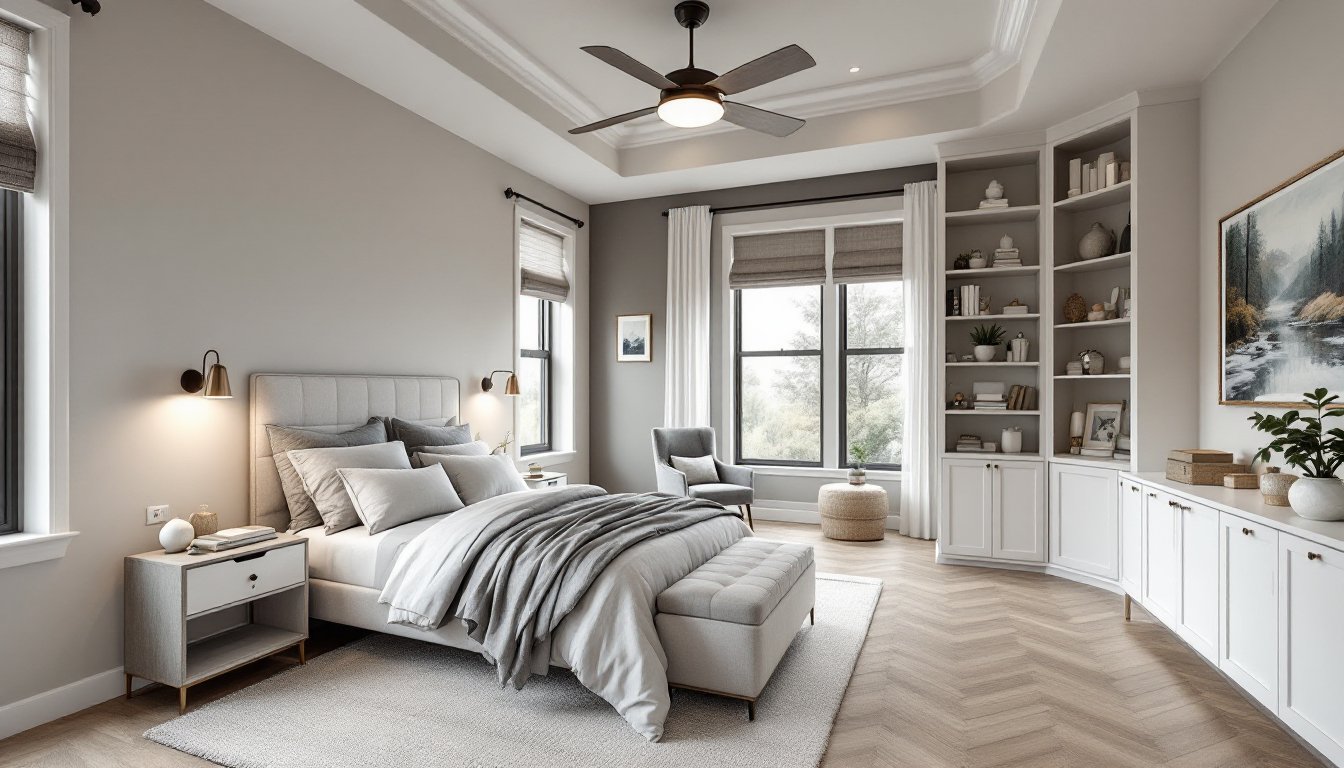
Color sets the emotional tone of your bedroom before you even unpack a suitcase. Cool neutrals like soft grays, warm whites, and muted blues promote relaxation and sleep, while warmer tones like terracotta or sage can create a cozy, grounded feeling.
When selecting paint, grab a few sample cans (most stores sell pints for a couple dollars) and paint large swatches on different walls. Light changes throughout the day, and what looks perfect at noon might feel off at dusk. Let samples sit for a few days before deciding.
Consider a feature wall, painting one wall in a deeper or slightly bolder shade while keeping others neutral adds visual interest without overwhelming the space. If you’re hesitant about commitment, wallpaper on a single accent wall offers impact and easier removal than paint. Always use quality primer, especially over existing colors or stains, to ensure even coverage and better paint adhesion. Matte or eggshell finishes work well in bedrooms since they don’t show dust as readily as glossy finishes.
Upgrading Lighting Fixtures for Ambiance and Function
Good lighting is both practical and transformative. A bright overhead fixture works during mornings and cleaning, but layered lighting, combining ceiling fixtures, bedside lamps, and wall sconces, gives you control over the room’s mood.
Bedside sconces mounted at approximately 24 to 30 inches above the nightstand eliminate the need for lamps that eat up surface space. Wall-mounted fixtures require running electrical wire through the wall, which may need a licensed electrician depending on your local building codes. If wiring seems daunting, battery-operated LED sconces or smart plugs controlling traditional lamps are quick alternatives.
Dimmer switches are game-changers. They let you adjust brightness without changing bulbs and save energy. Install dimmable LED bulbs (look for “dimmable” on the packaging) to avoid flickering. Warm white bulbs (2700K color temperature) promote better sleep than cool white, since blue light can interfere with melatonin production. Consider a ceiling fan with integrated lighting to handle air circulation and task lighting simultaneously, especially useful if your bedroom feels stuffy or runs warm.
Flooring Options That Combine Comfort and Style
Your feet touch the floor first thing in the morning and last thing at night, so comfort matters. Hardwood feels luxe and is easy to clean, but it’s cold underfoot without area rugs and can be noisy if you have squeaky subfloors (a structural issue best addressed by a professional if it’s structural).
Laminate or luxury vinyl planks (LVP) mimic hardwood at a fraction of the cost and handle moisture better, helpful if your bedroom is above a basement or in a humid climate. LVP is waterproof and floats over the existing subfloor without nailing, making DIY installation straightforward. Measure twice, acclimate planks to room temperature for 48 hours before installation, and use a moisture barrier underneath if installing over concrete.
Carpet and area rugs add warmth and softness. Wall-to-wall carpet installation typically requires professional help, but high-quality area rugs can define zones, place one under the bed and another at a seating area. Wool rugs are durable and naturally stain-resistant, though pricier. Synthetic alternatives offer similar comfort at lower cost. Whichever surface you choose, vacuum weekly and spot-clean spills immediately to extend the life of your investment.
Storage Solutions and Built-in Features
Clutter kills relaxation. Before buying furniture, audit what you’re storing, seasonal bedding, extra pillows, shoes, books, or work gear, and plan storage accordingly. A bedroom that feels spacious is one where everything has a designated home.
Built-in shelving, closet organizers, and under-bed storage maximize square footage. If building shelving from scratch, understand that a shelf’s span determines how thick material needs to be to avoid sagging. A 24-inch span can use 0.75-inch thick pine, but a 36-inch span needs 1.25 inches or a central support to prevent deflection. Install shelves into studs (16 inches on center) using lag bolts for load-bearing capacity.
Closet organizers, rod dividers, shelf risers, hanging organizers, are quick wins that don’t require tools beyond a drill and stud finder. Custom closet systems run $2,000 to $5,000+ depending on complexity, but DIY wire shelving kits cost under $200 and install in an afternoon. Consider a storage bench at the foot of the bed for blankets or seasonal items. The dual function, seating and storage, adds practicality without extra footprint. Avoid over-stuffing: breathing room between stored items prevents odors and pest problems.
Window Treatments for Privacy and Aesthetic Appeal
Windows frame your room and control light, temperature, and privacy. The right window treatments do all three, blackout curtains keep light out for better sleep, while sheer layers let you enjoy natural light during the day without losing privacy.
Roller shades, Roman shades, and cellular shades are clean, modern options that mount inside or outside the window frame. Cellular shades provide insulation: their honeycomb structure traps air and reduces heat loss in winter and heat gain in summer, lowering energy costs. Measure your window opening from side to side and top to bottom (at three points, top, middle, bottom, since frames aren’t always perfectly square) before ordering. Installation typically involves screwing mounting brackets into the window frame or wall. Most require only a level and a drill.
Curtains add texture and can block light more effectively than shades. Hang curtain rods closer to the ceiling than the window frame, which visually enlarges the room and improves light control when drawn. Use weighted curtain rods rated for your fabric’s weight, lightweight rods sag under heavy linen or velvet. Thermal-backed or blackout curtain linings ($15–30 per panel) dramatically improve light and temperature control. Layer a sheer curtain over a blackout panel for flexibility: sheers diffuse light during the day, and blackouts pull for total darkness at night.
Furniture Arrangement and Layout Optimization
Layout dictates flow and comfort. Measure your room and sketch furniture placement on graph paper before moving anything heavy, much easier than trial and error. Position the bed where you can see the door (a psychological comfort called the “command position”), and avoid centering it on the wall if possible: offset placement can make the room feel more intentional and less hotel-like.
Leave at least 2 feet of walking space on each side of the bed and at least 3 feet in front of dressers or nightstands. Nightstands don’t have to match or be symmetrical, asymmetrical arrangement feels more personal and contemporary than matching sets. Float furniture away from walls to define zones and improve air circulation: a grouping of chairs and a small table near a window creates a reading nook without cluttering the bed area.
Consider scale: oversized furniture in a small bedroom crowds the space, while tiny pieces in a large room feel lost. A bedroom is primarily a sleeping space, so don’t over-furnish. A bed, one or two nightstands, a dresser, and a comfortable chair or bench often suffice. If you share the space, a simple master bedroom renovation that adds seating and personal zones (his-and-hers reading lamps, separate dressers, a bench for him and a vanity for her) respects both occupants’ needs. Test arrangements for a week before anchoring furniture in place: what looks good on paper might feel awkward in practice.
Conclusion
A successful master bedroom renovation balances personal style with practical function. Start with color and lighting, the foundation of mood and usability, then layer in comfort through flooring and window treatments. Smart storage and thoughtful layout prevent clutter and maximize space. Whether you’re tackling a full diy bathroom renovation or a master bedroom overhaul, the same principles apply: measure twice, prep thoroughly, and prioritize function alongside aesthetics. Your bedroom should feel like yours, not a showroom. Take your time, make intentional choices, and enjoy the process of creating a personal retreat.