
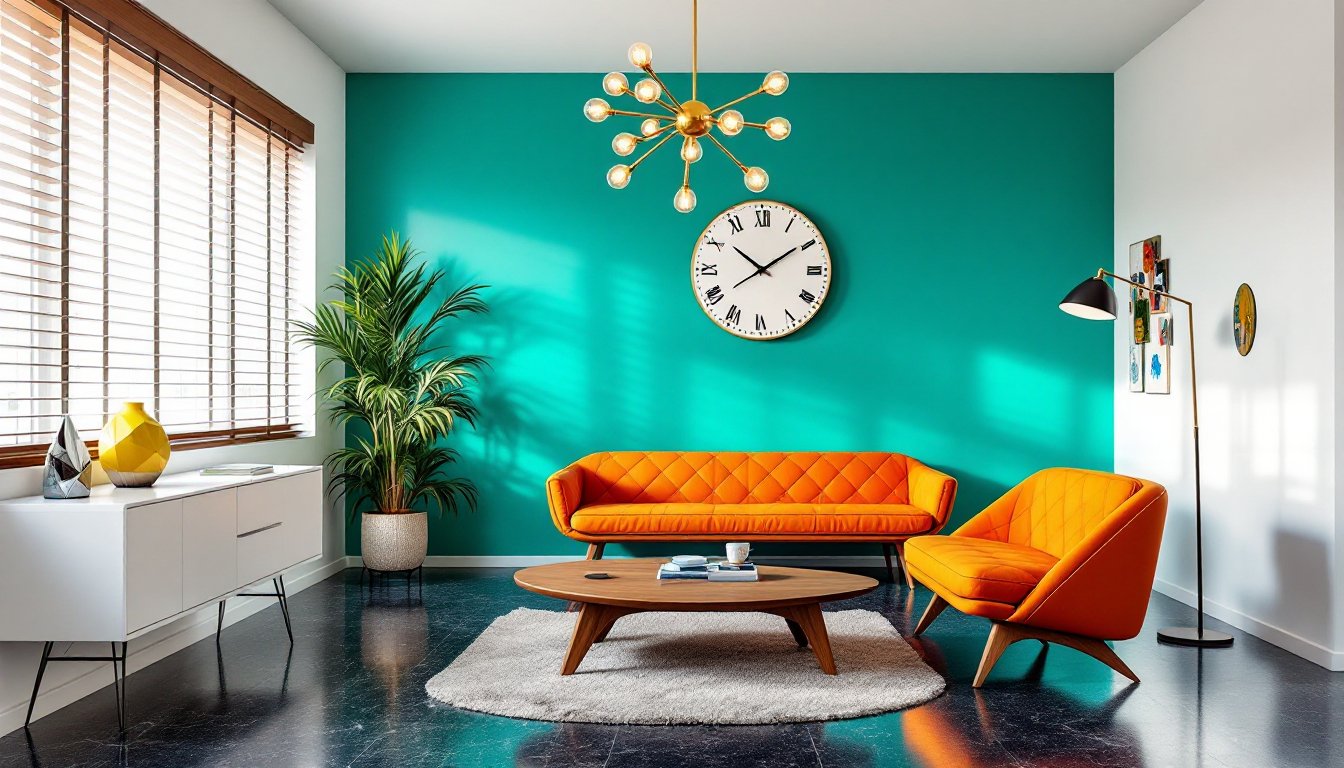
Googie design isn’t subtle. It’s the swooping rooflines of 1950s diners, the starburst clocks that hung in mid-century rec rooms, and the atomic-age optimism that thought we’d all be commuting by jetpack. Born during the Space Race, Googie blended futurism with accessibility, bold geometry, neon accents, and a sense that tomorrow would be shinier than today. While its heyday faded by the 1970s, Googie’s aesthetic has seen a resurgence as homeowners look for alternatives to the beige minimalism that’s dominated for years. Bringing Googie indoors means more than hanging a starburst mirror. It’s about capturing that forward-looking energy through deliberate material choices, color contrasts, and structural forms that feel both playful and intentional.
Key Takeaways
- Googie interior design combines bold geometric shapes, vibrant colors, and space-age optimism inspired by 1950s–60s futurism, offering a refreshing alternative to minimalist home aesthetics.
- Essential Googie elements include Sputnik chandeliers, color-blocked walls in saturated primaries and turquoise, tapered furniture legs, and high-gloss finishes that emphasize retro-futuristic flair.
- Start incorporating Googie with statement pieces like a single accent wall or reproduction chandelier, then balance bold furnishings with neutral backgrounds to avoid an overwhelming theme-restaurant feel.
- Googie style works best in dining rooms, home bars, basements, and bathrooms, but should be avoided in spaces requiring calm like bedrooms and nurseries where its energetic aesthetic conflicts with relaxation.
- Budget-friendly Googie transformations come from thrifted vintage pieces, high-gloss paint projects, DIY geometric wall treatments using dowels or painter’s tape, and reupholstered furniture in retro vinyl fabrics.
- Materials matter: prioritize modern equivalents like powder-coated steel, lacquered panels, and luxury vinyl plank over authentic terrazzo or Formica to balance authenticity with practical durability.
What Is Googie Interior Design?
Googie (sometimes called “populuxe” or “doo-wop”) emerged in Southern California during the late 1940s and peaked through the 1960s. The style takes its name from a now-demolished Los Angeles coffee shop designed by architect John Lautner. It’s defined by upswept angles, cantilevered forms, atomic motifs, and an exuberant faith in technology and space exploration.
While Googie is most visible in commercial architecture, think vintage bowling alleys, car washes, and roadside diners, its influence filtered into residential interiors through furniture, lighting, and decor. Homeowners embraced boomerang coffee tables, kidney-shaped pools, and wall clocks shaped like sunbursts or atoms. The aesthetic married modern materials (steel, Formica, glass) with vibrant color blocking and asymmetry.
Today’s interpretation blends vintage authenticity with contemporary living needs. You’re not recreating a museum piece: you’re adapting a visual language that emphasized optimism, movement, and a little showmanship. That means knowing when to commit to a bold accent wall or statement light fixture, and when to dial it back so your space doesn’t feel like a theme restaurant.
Key Elements of Googie Interior Design
Geometric Shapes and Futuristic Forms
Googie lives in the angles. Look for furniture and fixtures with sharp triangles, exaggerated ovals, parabolic arcs, and asymmetrical silhouettes. Starburst motifs, radiating spokes from a central hub, show up everywhere, from wall art to cabinet hardware.
Structurally, Googie interiors often feature cantilevered shelving, floating staircases, or built-in benches that appear to defy gravity. If you’re planning custom millwork, consider integrating angled supports or tapered legs rather than standard vertical posts. A floating credenza mounted on steel hairpin legs feels more Googie than a boxy IKEA unit.
Lighting is another opportunity. Sputnik chandeliers, those multi-armed fixtures with bulbs at the end of each spoke, are the most recognizable Googie lighting element. Alternatives include pendant lights with molded acrylic shades in asymmetric shapes or floor lamps with tripod bases and conical shades. Avoid overly ornate or traditional fixtures: Googie celebrates industrial materials and space-age simplicity.
Bold Colors and Contrasting Palettes
Googie interiors don’t whisper. The palette centers on saturated primaries (red, yellow, blue), tangerine orange, turquoise, and chartreuse, often set against white, black, or gray neutrals. These aren’t Scandinavian pastels, they’re the colors of vintage neon signs and Formica countertops.
Color blocking is essential. Rather than blending hues, Googie design juxtaposes them sharply: a turquoise accent wall against white cabinetry, a yellow sofa on charcoal terrazzo, or red bar stools flanking a white laminate counter. If you’re painting, use high-gloss or semi-gloss finishes to amplify the retro-futuristic vibe. Flat paint feels too muted.
Materials also carry color. Vintage Googie interiors featured brightly colored Formica, vinyl upholstery, enameled steel, and tinted glass. Modern equivalents include powder-coated metal furniture, lacquered MDF panels, and acrylic or resin accents. Texture matters less than sheen and saturation.
How to Incorporate Googie Style Into Your Home
Start with one or two statement pieces rather than a full-room overhaul. A vintage or reproduction Sputnik chandelier can anchor a dining room or entryway. Pair it with simpler furnishings so the fixture remains the focal point.
Furniture with tapered or splayed legs, common in mid-century modern design, aligns well with Googie aesthetics. Look for pieces with boomerang or kidney shapes: a curved sofa, an asymmetric coffee table, or a bar cart with angled supports. Reupholstering thrift-store finds in bold vinyl or textured fabric (like ribbed or diamond-tufted patterns) is a budget-friendly path if you’re handy with a staple gun and foam padding.
Wall treatments offer another entry point. Consider an accent wall in high-gloss turquoise or tangerine, or install decorative wall panels with geometric relief patterns. Wood slat walls, popular in the 1950s and 1960s, can be recreated with 1×2 furring strips spaced evenly and painted in contrasting colors. Secure them to studs or use construction adhesive over drywall: spacing should be consistent (typically 4–6 inches on center) for a clean look.
For flooring, Googie interiors often showcased terrazzo, vinyl tile, or polished concrete, all durable, easy-to-clean surfaces that suited the era’s embrace of modern convenience. If you’re renovating, luxury home design publications showcase high-end terrazzo installations, though DIY-friendly alternatives include luxury vinyl plank (LVP) with geometric inlays or poured epoxy floors with embedded color chips. Full terrazzo installation requires professional equipment and expertise: it’s not a weekend project.
Accessories seal the deal. Hunt for vintage starburst clocks, atomic-print throw pillows, or sculptures with freeform biomorphic shapes. Etsy, estate sales, and mid-century specialty shops are reliable sources. Reproductions are widely available, but check materials, many modern knockoffs use lightweight plastic instead of the enameled metal or molded resin that gives authentic pieces their heft and finish.
Where Googie Design Works Best in Modern Homes
Googie thrives in spaces where boldness is expected: home bars, game rooms, media rooms, and finished basements. These areas tolerate visual risk better than, say, a nursery or a home office where focus matters more than flair.
Kitchen and dining areas are natural fits. Install a Sputnik chandelier over a dining table, add vinyl bar stools in primary colors, or replace cabinet hardware with starburst or atomic-shaped pulls. If you’re updating countertops, consider laminate in bold colors rather than the ubiquitous granite or quartz. Modern laminates have improved dramatically in durability and can mimic vintage Formica patterns.
Living rooms can handle Googie accents if balanced carefully. A single statement sofa in turquoise vinyl, paired with a boomerang coffee table and a starburst mirror, creates a retro focal point without overwhelming the space. Keep walls neutral if you’re going bold with furnishings, or flip it: bold walls with restrained furniture.
Bathrooms offer surprising opportunity. Vintage Googie bathrooms featured colored tile (pink, turquoise, yellow), terrazzo floors, and chrome fixtures with geometric detailing. Retiling a bathroom is a moderate DIY if you’re comfortable with thinset mortar, grout, and a wet saw, but waterproofing (using a membrane like Schluter or RedGard) is non-negotiable. Tile layout should emphasize geometry, consider diagonal patterns or contrasting grout lines.
Avoid Googie in spaces that benefit from calm: bedrooms, home offices, or nurseries. The style’s energy works against relaxation and concentration. If you love the aesthetic but need versatility, confine it to removable elements, art, lighting, textiles, that can be swapped out as tastes evolve.
DIY Tips for Creating a Googie-Inspired Space on a Budget
Thrift and hunt. Googie’s golden age produced millions of mass-market items that are still floating through estate sales, thrift stores, and online marketplaces. Focus on smaller pieces first: clocks, lamps, barware, and wall art. Larger furniture (sofas, credenzas) can be pricey in mint condition, but pieces needing reupholstery or refinishing are often affordable.
Paint is your best tool. High-gloss paint in bold colors transforms bland furniture or walls. Use a quality primer (oil-based for laminates and metal, shellac-based like BIN for stain blocking) and apply at least two topcoats for even coverage. A quart of high-gloss enamel costs $15–25 and covers roughly 100 square feet. Sand lightly between coats (220-grit) for adhesion.
DIY geometric wall treatments. Create a starburst wall sculpture using wooden dowels (1/4-inch or 3/8-inch diameter) radiating from a central plywood disc. Cut dowels to varying lengths, drill holes around the disc perimeter, glue the dowels in place, and paint the entire assembly in a bold color. Mount it with a French cleat or heavy-duty adhesive. Total material cost: under $30.
Another budget option: paint a large-scale geometric mural. Use painter’s tape to mask off triangles, parallelograms, or interlocking circles, then fill each shape with a different bold color. Work on a primed wall for best results, and remove tape while paint is still slightly tacky to avoid peeling. Many home decorating ideas platforms feature photo galleries that can inspire layout and color combinations.
Reupholster or slipcover existing furniture. Vintage-look vinyl fabric (search for “retro vinyl upholstery” or “mid-century Naugahyde”) runs $15–30 per yard. A dining chair seat typically needs 1/2 to 3/4 yard. Remove the seat, strip old fabric and padding, add new high-density foam (2-inch thickness for comfort), wrap with batting, then pull vinyl taut and staple to the underside with a heavy-duty staple gun (Arrow T50 or similar). Work from center to corners, keeping tension even.
Source reproduction hardware and lighting. Online retailers and home improvement stores now stock mid-century and Googie-inspired fixtures at accessible price points. A basic Sputnik-style chandelier starts around $80–150: quality improves significantly above $200. When selecting lighting, verify it’s UL-listed and compatible with your dimmer switches if applicable. Installation is straightforward if you’re comfortable with basic electrical work (turn off the breaker, match wire colors, secure the mounting bracket). If you’re unsure or local code requires it, hire a licensed electrician.
Prioritize impact over authenticity. You’re not curating a museum. If a modern piece captures the right geometry and color, it works. Googie was never about preciousness, it was about accessible optimism and a little bit of showmanship. For further inspiration on blending vintage and modern elements, real estate and design trends often highlight retro revivals in contemporary homes.
Safety note: When working with power tools (saws, drills, sanders), always wear safety glasses and hearing protection. If you’re painting or working with adhesives in enclosed spaces, ensure adequate ventilation and consider a respirator with organic vapor cartridges, especially when using oil-based products or spray paints.